

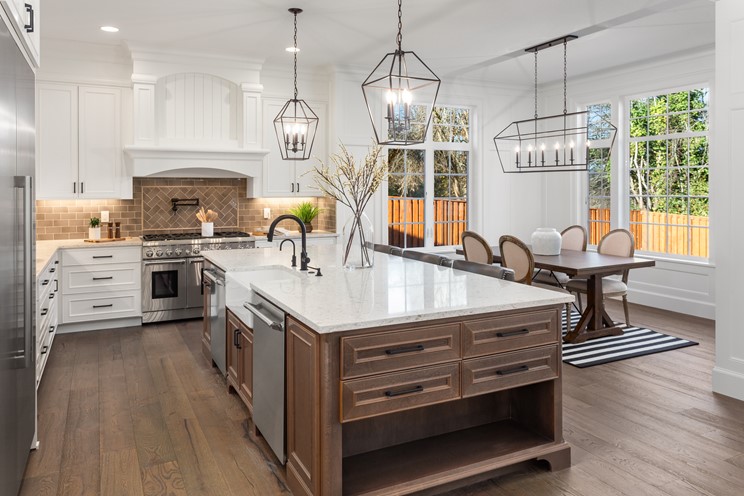
Picking out a kitchen countertop is exciting until the slab yard sales associate asks one quiet question: "Two centimeters or three?" Suddenly the conversation shifts from veining and color to numbers, edges, and structural support. Thickness is one of those quiet decisions that shapes the entire feel of a kitchen, and most homeowners only think about it once.
At Generation Floors, we have spent decades guiding families in Kaysville, Layton, Farmington, Syracuse, Centerville, and Clearfield, UT through this exact crossroads. The right thickness depends on your style, your stone, your cabinets, and how you actually live. Before you sign off on a slab, walk through the five points below with us, and treat it like a conversation rather than a checklist. If you want a deeper look at how different surfaces perform under daily wear, our guide to countertop materials that hold up to heat and stains is a helpful companion read.
The thickness basics worth knowing first
Most kitchen countertops are sold in two standard thicknesses: 2 cm (about 3/4 inch) and 3 cm (about 1 1/4 inch). A 3 cm slab feels sturdier underhand and usually does not need a plywood subtop, while a 2 cm slab is lighter, often more affordable, and frequently reinforced from underneath.
Quartz, granite, marble, and porcelain all show up in both thicknesses, but availability shifts by color and brand. Knowing this baseline keeps the rest of the decision grounded.
1. Match thickness to the material you love
Different stones behave differently at different thicknesses. Natural granite and marble usually look richer at 3 cm because the depth lets the veining breathe. Quartz handles 2 cm beautifully thanks to its engineered consistency, and porcelain slabs are often designed specifically for thinner profiles.
If you have already fallen for a particular slab, ask which thicknesses it comes in before you commit. Some exotic stones are only quarried in one size, and that single fact can decide the whole project.
2. Consider your cabinets and structural support
A 3 cm countertop is heavier, sometimes meaningfully so on long runs or large islands. Older cabinets, floating shelves, or unsupported overhangs may need reinforcement, and that conversation should happen before the slab is cut.
When we plan a kitchen remodeling project, we always check cabinet boxes, corner braces, and overhang spans first. A countertop is only as solid as what sits beneath it.
3. Think about the edge profile you want
Edge profiles read very differently on 2 cm versus 3 cm slabs. A 3 cm edge can carry a bold ogee, a chunky chiseled finish, or a clean square look without feeling forced. A 2 cm edge often gets built up with a laminated mitered edge to mimic that thicker presence.
If you love a soft, modern, mitered waterfall island, both thicknesses can deliver. If you want a substantial, solid feel without seams, 3 cm tends to win.
4. Weigh the budget conversation honestly
Thicker slabs typically cost more per square foot, but the math is rarely that simple. A 2 cm install may add the cost of a plywood subtop and edge build-ups, which can narrow the gap.
Pricing also shifts based on stone rarity, fabrication time, and how many cutouts your layout needs. A clear quote should break these pieces apart so you can compare apples to apples.
5. Picture the daily lifestyle test
Finally, picture a regular Tuesday night. Hot pans, kids leaning on the island, groceries plopping down, a heavy stand mixer sliding into place. A 3 cm slab feels reassuring under that kind of action, while a well-supported 2 cm install can perform just as well with the right fabrication.
Your habits matter more than the spec sheet. A baker, a busy host, and a minimalist cook may each land in a different place, and that is exactly how it should be.
Talk to our countertop team before you commit
We at Generation Floors love walking homeowners through this decision in person, slab by slab, with no pressure and plenty of honest input. Schedule a free in-home estimate and we will help you weigh thickness, edges, cabinets, and budget together. Your kitchen deserves a surface that fits the way you actually live.


