

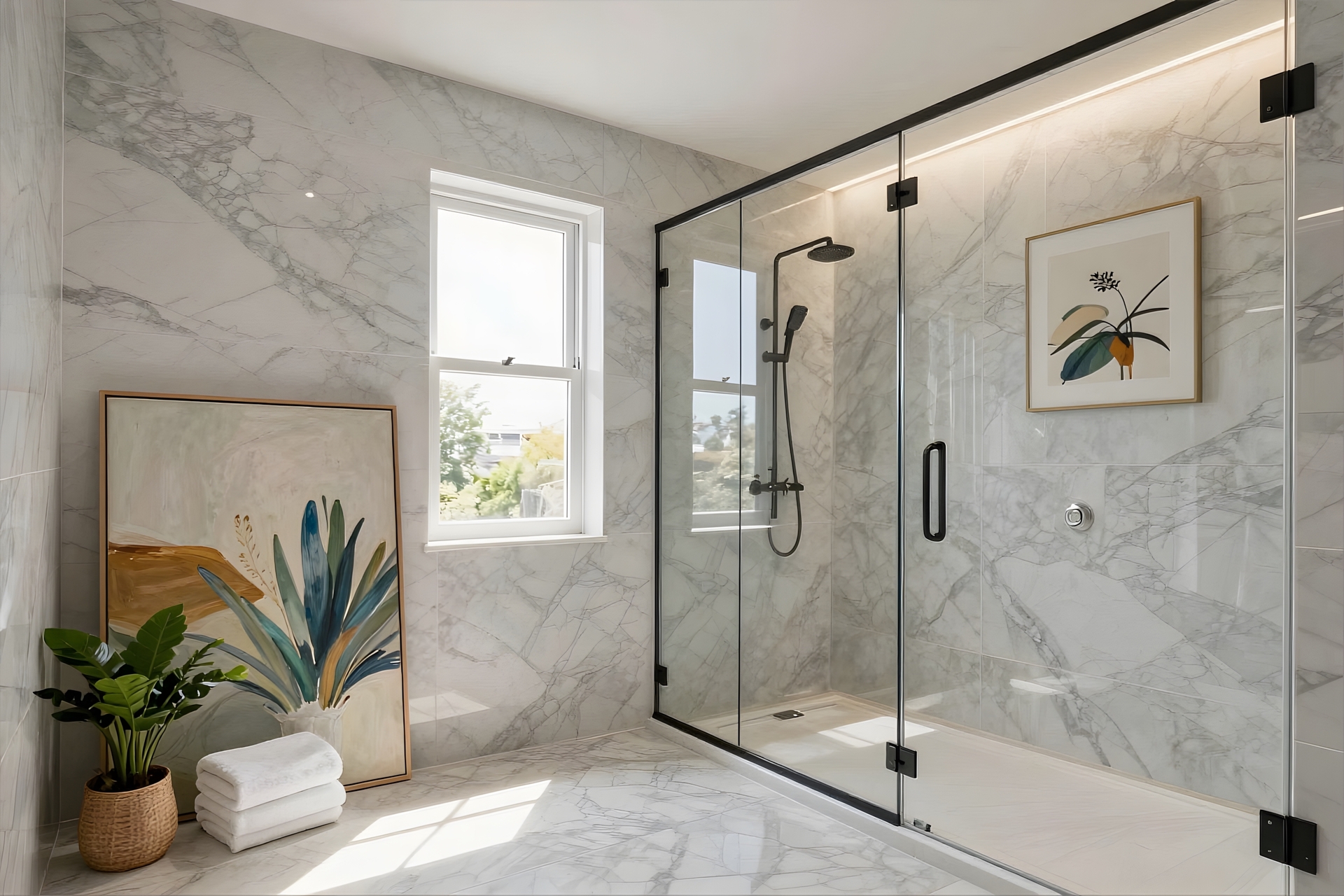
There's a decision that comes up in almost every bathroom remodeling project that people tend to underestimate until they're standing in a showroom holding two different hardware samples. Frameless or framed? It sounds like a small call. It isn't. The shower enclosure you choose shapes how the entire bathroom feels, how easy it is to clean, and how well it holds up over years of daily use.
Here's what you actually need to know before you decide.
The case for frameless
Frameless shower enclosures are exactly what they sound like: thick tempered glass panels with no metal frame running along the edges. The glass is typically 3/8 to 1/2 inch thick, heavy enough to stand on its own, and the hardware holding it in place sits discretely at the hinges and wall brackets.
The visual result is clean and open. Without a frame interrupting the sightline, the shower tile behind the glass becomes part of the room rather than something tucked behind metal. For bathrooms where you've invested in beautiful tile work, large-format stone, or a custom mosaic floor, frameless glass lets all of it breathe.
Frameless enclosures are also significantly easier to keep clean. Metal frames collect soap scum and moisture in the joints. Without them, a squeegee and a quick wipe handles most of what a shower throws at the glass.
The honest tradeoff: frameless enclosures cost more. The thicker glass, the precision hardware, and the more exacting installation all add up. If budget is a real constraint, that matters.
The case for framed
Framed enclosures use thinner glass, typically 3/16 inch, supported by an aluminum frame around the perimeter. That frame provides structural stability, which is why framed units have been the standard for decades.
They're more forgiving during installation, particularly in bathrooms where walls aren't perfectly plumb or square. The frame compensates for small imperfections in a way that frameless glass simply cannot. In older homes, this is often more relevant than people expect.
Framed enclosures are also more accessible from a cost standpoint without sacrificing durability. A well-made framed unit with quality hardware will perform reliably for many years. The tradeoff is the cleaning reality. Those frame channels require more attention, and grout-like buildup in the metal edges is something homeowners deal with regularly.
So which one is right for your bathroom?
The answer depends on three things: your budget, the condition of your walls, and how much the shower tile matters to your overall design vision.
If you've chosen striking countertops and tile that you want to feel cohesive across the whole bathroom, frameless glass keeps the design conversation going. If you're working with a tighter budget or an older bathroom where walls have some variance, framed gives you a reliable, good-looking result without the complications.
Both options, when installed with care and quality materials, will serve you well. The difference is in the details.
Let's build a bathroom worth stepping into every day
We work with homeowners across Kaysville, Layton, Farmington, Syracuse, Centerville, and Clearfield to make bathroom remodels feel personal, not just functional. Request a free estimate and our team will walk you through every decision, start to finish.


